
Most cat toys stop working for one reason. The hunt never finishes. A cat searches, stalks, chases and pounces, then needs to catch something and get their teeth into it. A toy that can never be caught leaves the hunt half done, so your cat loses interest.
If your cat lives indoors, or mostly indoors, every hunt they get is one you set up. The fix is usually in how the toys are used, not in buying more of them.
Why cat toys stop being interesting so quickly
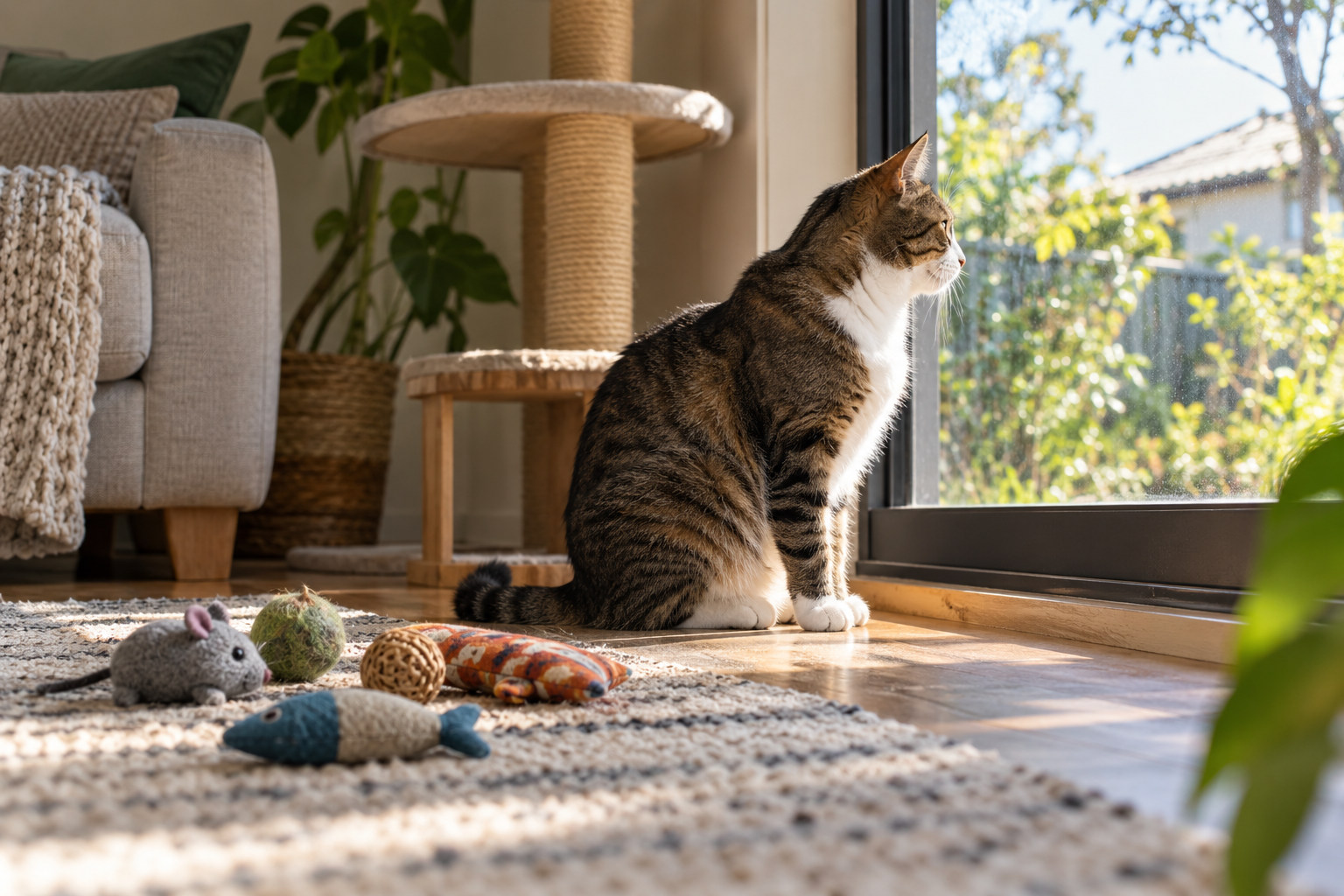
Cats get used to things quickly. Behaviour specialists call that habituation. It means a cat stops reacting to something they have met many times before.
International Cat Care describes this with a small furry mouse-sized toy. Once it has been caught and killed, it soon loses its appeal. Their advice is to keep two or three toys on the go and rotate them. Give your cat one at a time, so each one keeps its novelty.
A basket of twelve toys, all out at once, is twelve toys your cat has stopped noticing. The cat asleep on the cat bed beside it is not being fussy. Put ten of them in a cupboard. Bring one out for a few days, then swap it for another. RSPCA Australia suggests rotating through a few activities to keep things interesting.
If there is a dog in the house, the reasons a dog ignores most of their toys are different again.
What a cat is doing when it plays
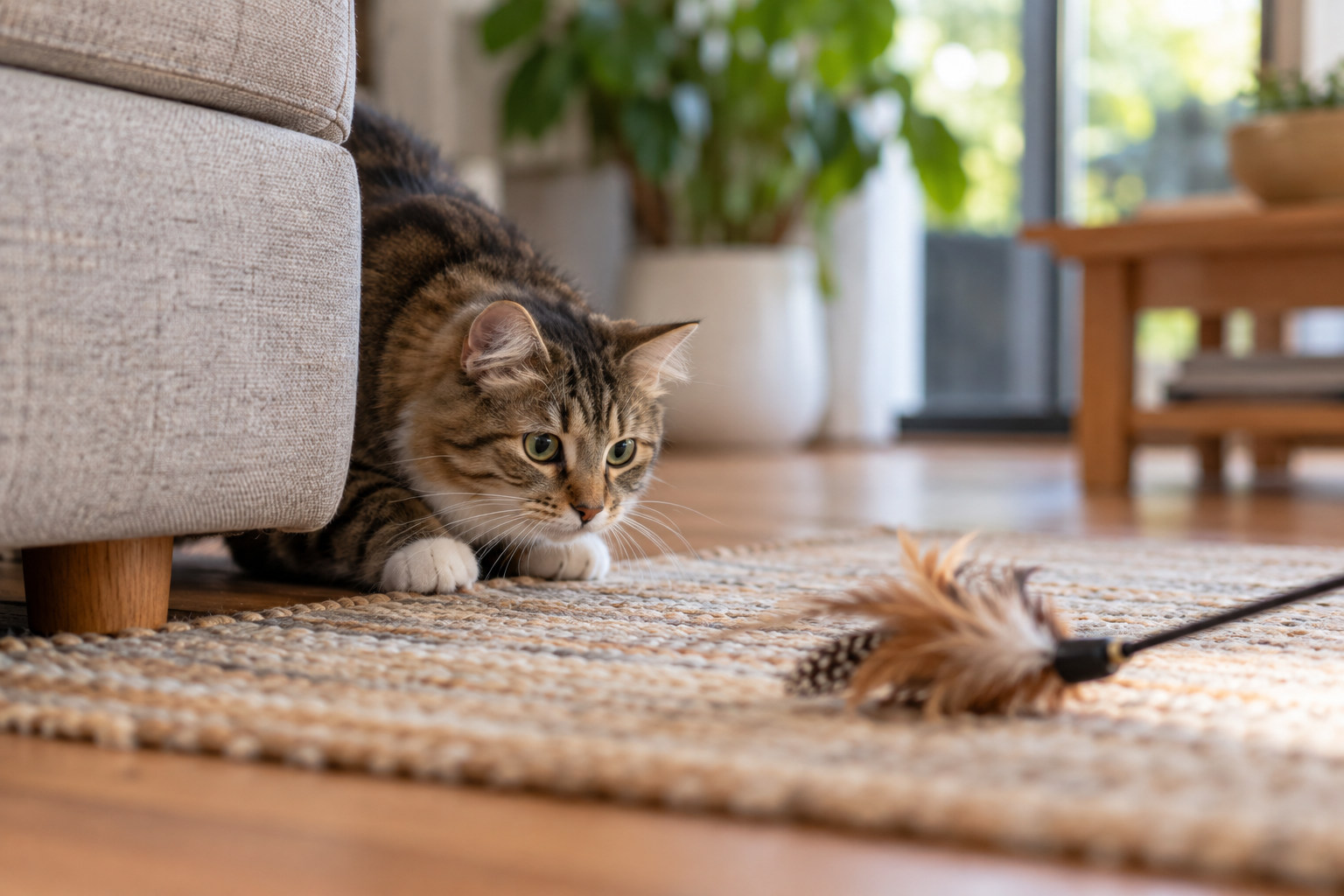
Play is hunting practice, and a hunt runs in a set order. International Cat Care sets it out as search, stalk, chase, pounce, catch and manipulate. The last two parts are the payoff. A hunt that stops before them leaves your cat part way through.
This is where the laser pointer goes wrong. It lets a cat stalk, chase and pounce. There is nothing at the end to catch. International Cat Care’s advice is to put the laser away and switch to a wand toy, so the game ends on a positive note.
It also explains the scruffy toy your cat carries around the house. Catching and carrying is the end of the sequence. A soft toy the right size is often the only thing in the room that allows it.
Why wand toys work when nothing else does
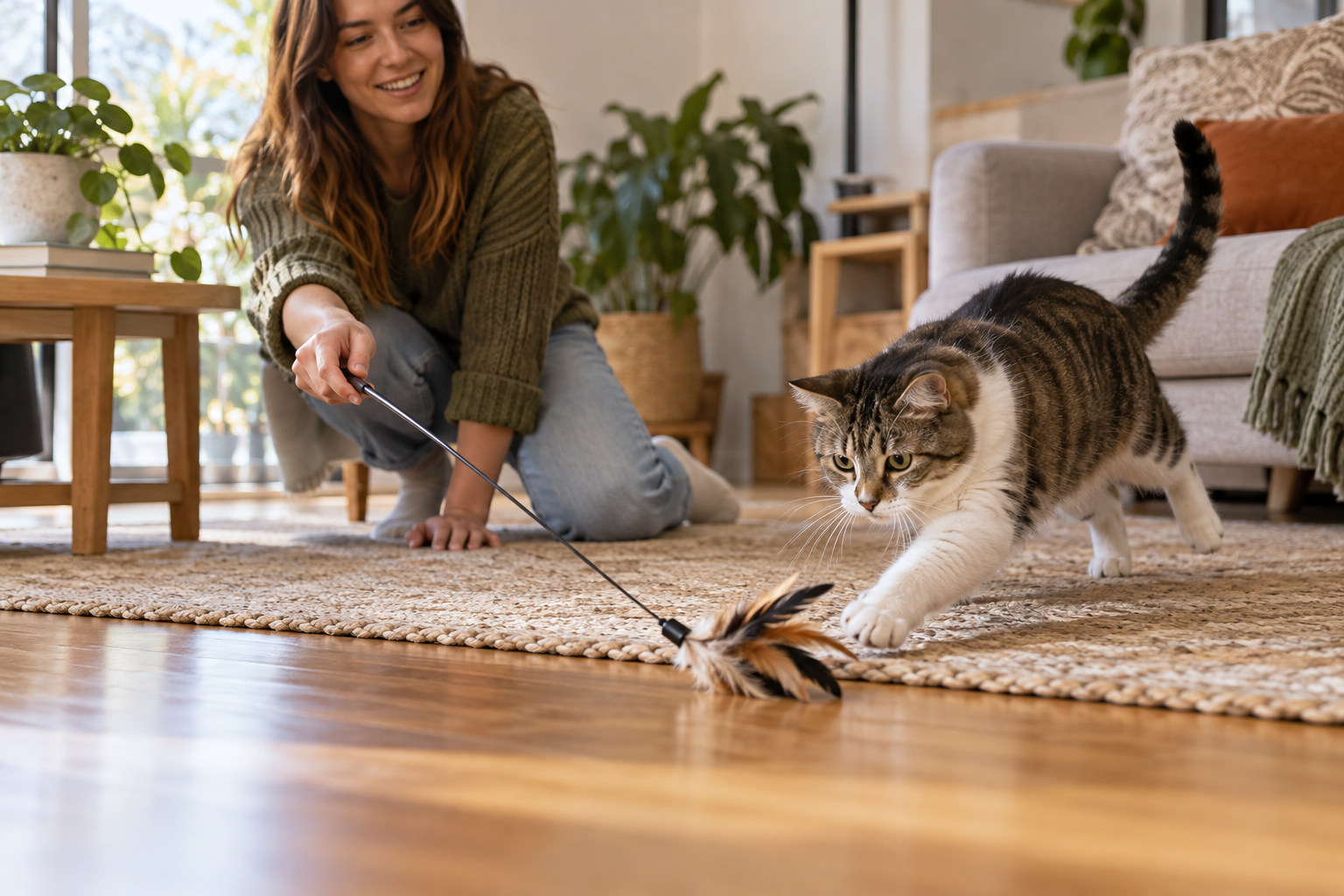
A wand toy is a stick with a string and a lure on the end. You move it, not the cat. That lets you make the lure behave like prey: short darts, a pause behind a chair, then a moment where your cat gets it.
The finish is the part people skip. Let your cat catch the lure a few times. End the session with a catch, rather than by walking off mid chase.
Two safety points come with wand toys. Put the wand out of reach when the game ends, which is what International Cat Care advises. String is the reason. The same guidance warns against toys made of ribbon or string, and balls of wool. A cat that swallows them can end up with bunched intestines and emergency surgery.
Wands also sort out the cat that plays with hands. Hands teach a cat that skin is fair game. International Cat Care says never to use your hands or feet to play with a kitten. A lure gives them something better to bite.
Puzzle feeders, and the second job they do
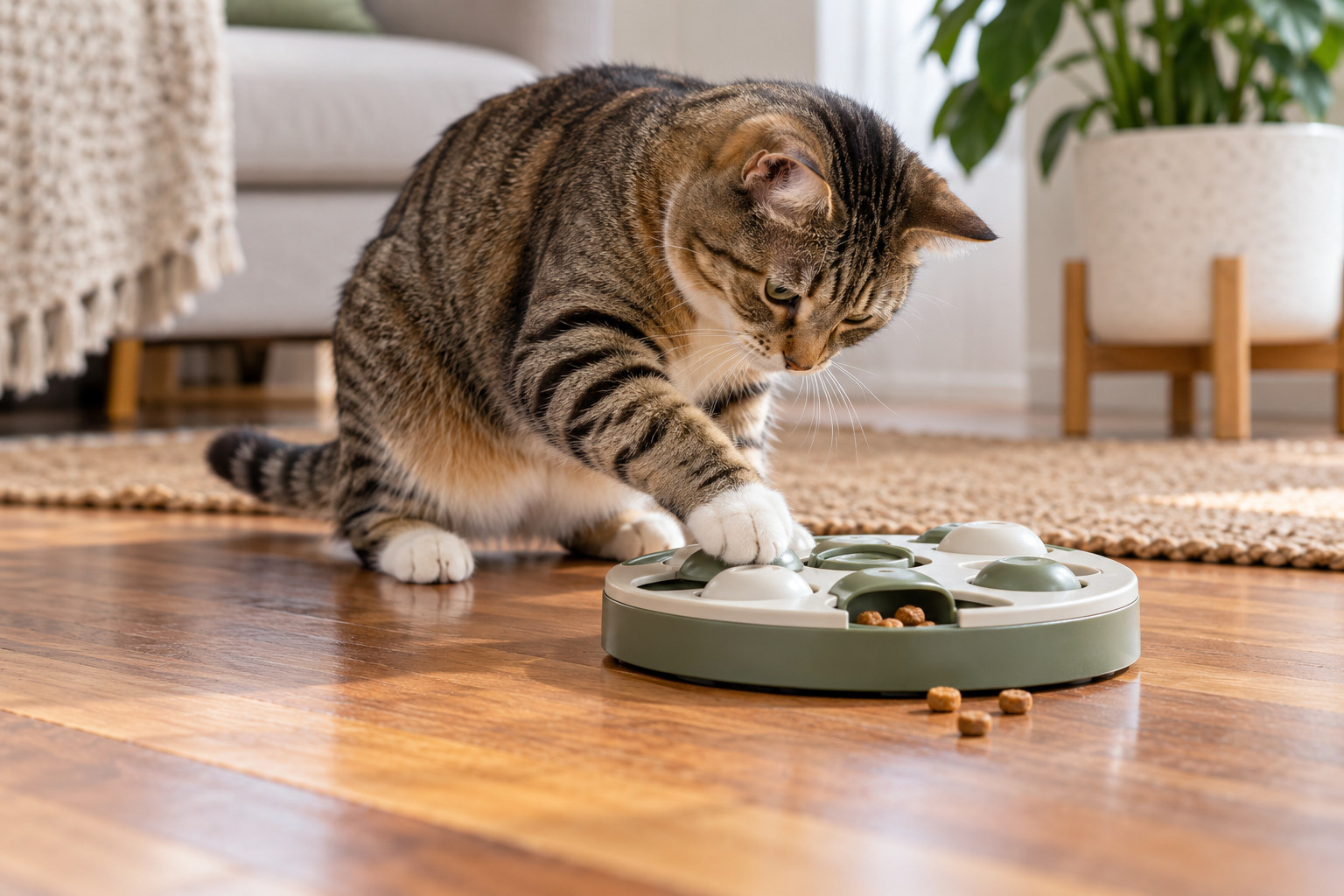
A puzzle feeder is a container that holds food and has to be pawed, tipped or rolled to let it out. International Cat Care says puzzle feeders make meals last longer. They also add physical activity and give a cat a brain teaser.
The second job is boredom. Without the stimulation of interacting with their surroundings, the same guidance says, a cat may become bored. That can cause anxiety and lead to problem behaviours. A cat who only has to walk to their food bowl is also taking in more calories than they use.
Introduce one gradually. Keep part of the daily food in the normal bowl at first. Set the feeder so the food comes out easily. Then give more of the meal through the feeder as your cat works it out.
You do not have to buy one to try it. The RSPCA’s low-cost enrichment guide describes cutting small holes in a toilet roll. Fold and tape one end, then fill it with kibble. Scattering a handful of kibble around a room works too, and gives the searching part of the hunt something to do.
Does catnip work on every cat?
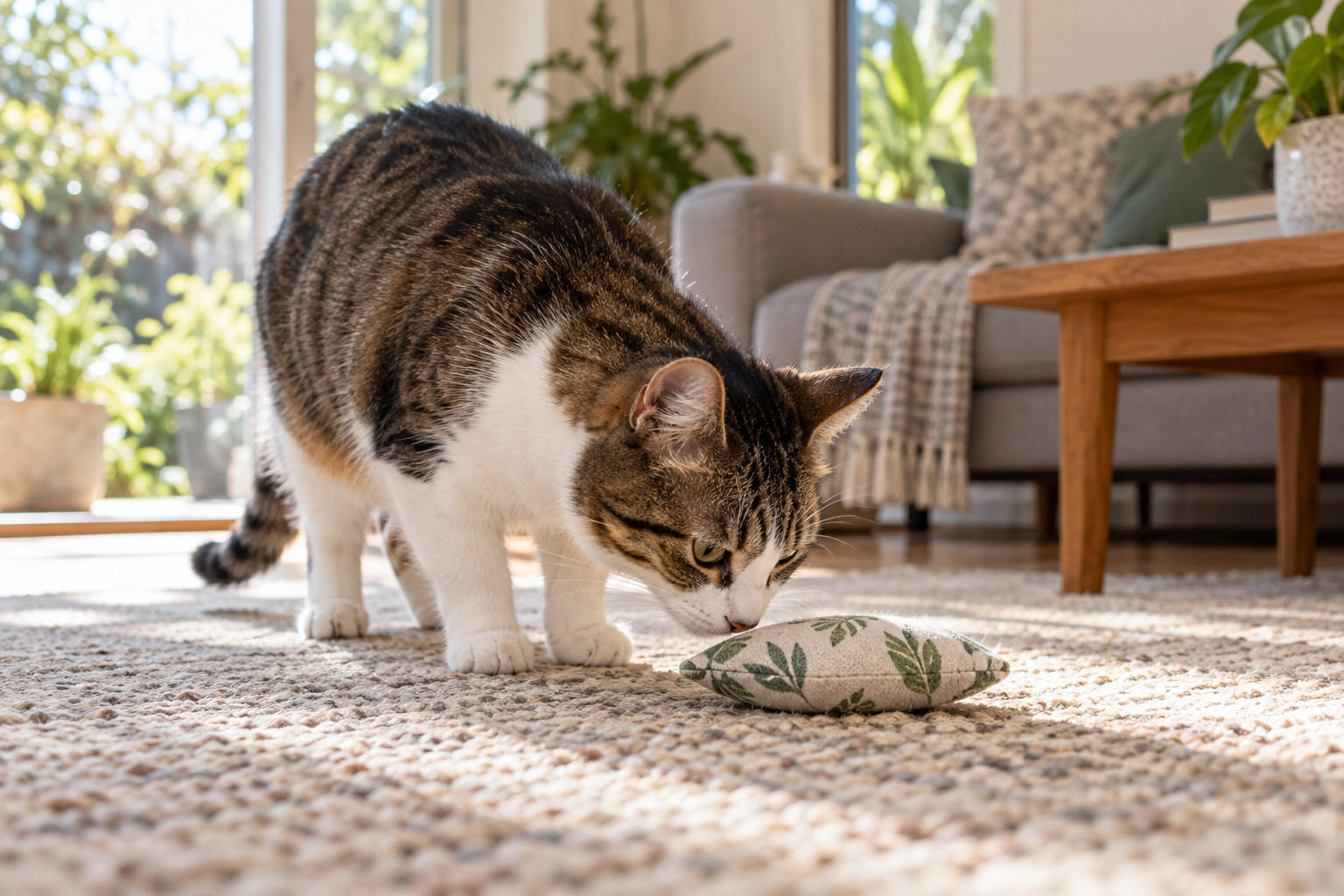
No. A 2017 study by Bol and colleagues in BMC Veterinary Research reports that about one in every three domestic cats does not respond to catnip. A catnip toy that does nothing for your cat is normal. It is not a fault in the toy.
The same study tested silver vine, a plant used in much the same way. Most of the cats that ignored catnip did respond to silver vine. RSPCA Australia also names catnip and silvervine sticks among the cheap ways to get a cat interested.
Catnip is a dried herb, and International Cat Care describes it as exciting many but not all cats. If your cat shrugs at it, silver vine is the next thing to try. A stronger catnip toy is not.
How much play does an indoor cat need?
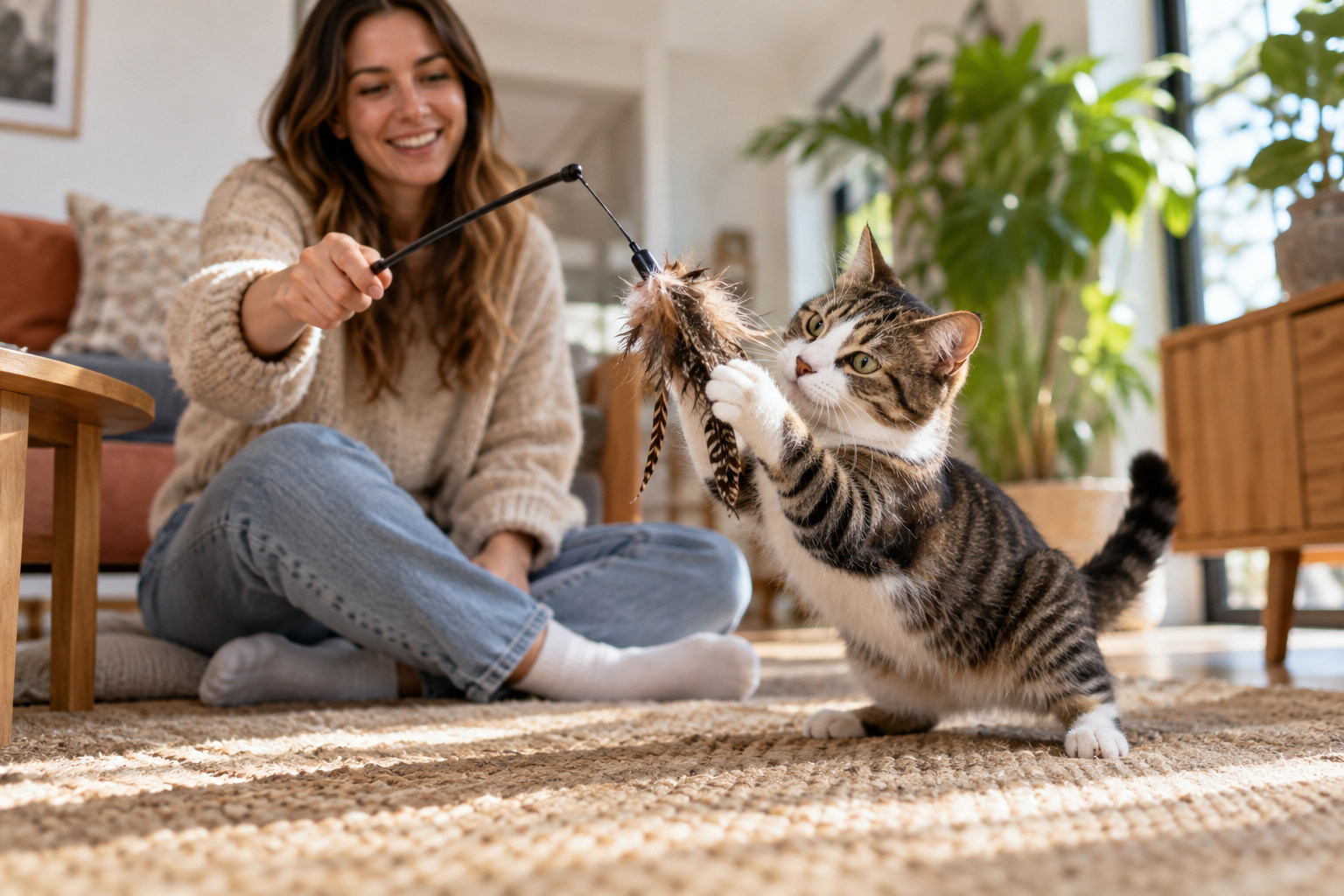
Short and often beats long and scheduled. International Cat Care puts it plainly: cats are sprinters rather than marathon runners. One minute of frenzied activity is a good result.
Timing does more work than total minutes. Cats are naturally more active at certain times of day, often dawn and dusk. Two or three short games around those hours land better than one long session in the afternoon.
RSPCA Australia explains why this matters more for a cat kept inside. A contained cat needs choice about where they rest, play and toilet. They also need chances to stalk, pounce, climb, scratch, hide, retreat and explore. Keeping cats contained in an environment that meets those needs, the RSPCA says, helps them thrive rather than just survive.
Travel is the other part of indoor life your cat gets no say in. Choosing a carrier your cat will tolerate is a job of its own.
Frequently asked questions
Why does my cat ignore a brand new toy?
A new toy has to move like prey before a cat treats it as prey. Left on the floor, it is furniture. Pick it up, make it dart and hide, and let your cat win it.
Should I leave cat toys out all the time?
Leaving the whole lot out is what makes them dull. Keep most of them in a cupboard and have one or two in the room. Swap them every few days and the same toys feel new.
Is a laser pointer bad for my cat?
The problem is the ending, not the light. Nothing is ever caught, which is the part your cat is playing for. Use it to get them moving, then swap to something they can grab.
What can I try if catnip does nothing for my cat?
Silver vine is the usual next step. It is sold as sticks as well as in toys. If neither plant does anything, lean on movement instead of scent.
My cat only wants to play at night. What can I do?
Give them a proper hunt in the evening. A short, hard game before your own bedtime, finished with a catch, uses up the energy that would otherwise arrive in the small hours.
Where to start with the cat you have
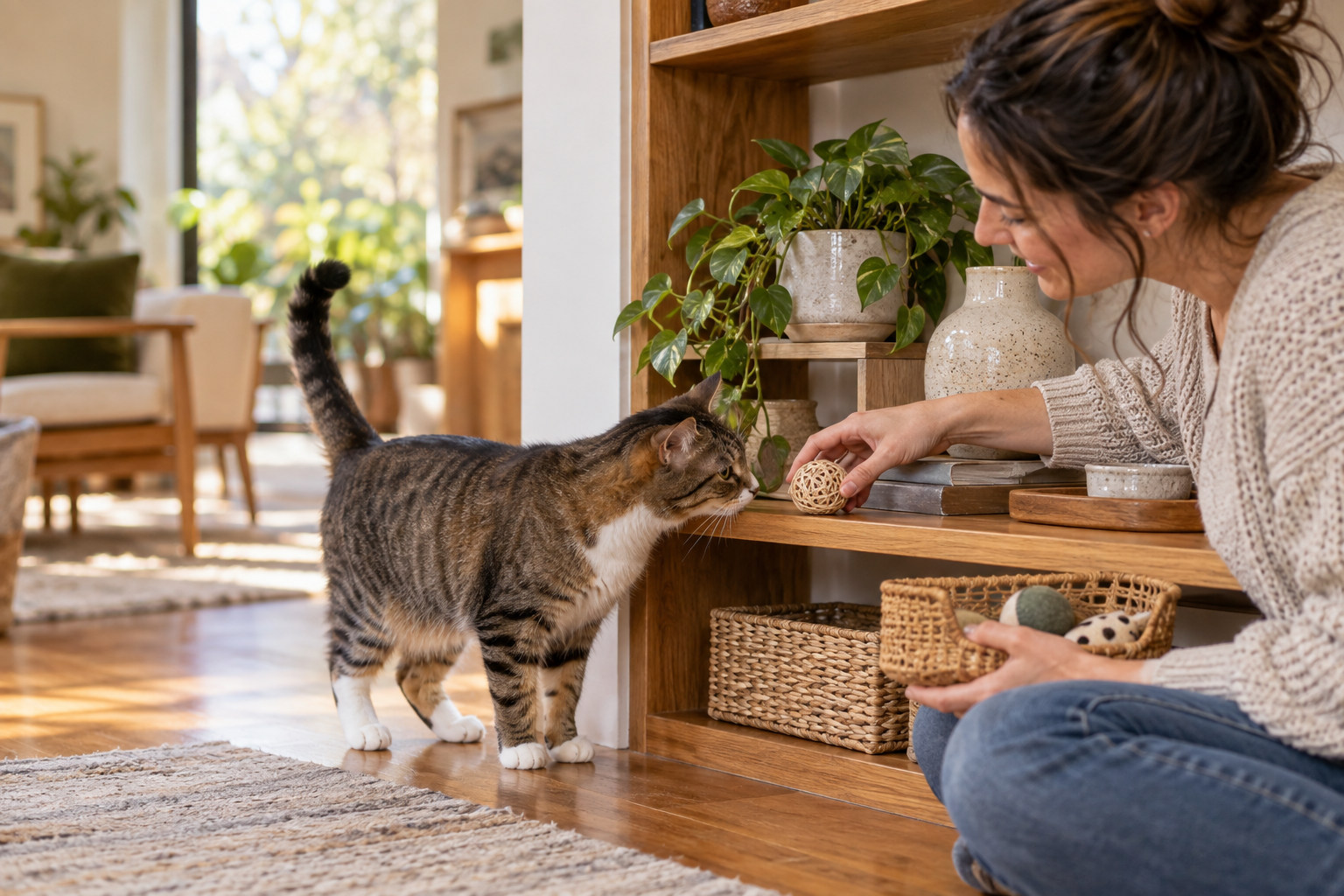
If you are in Ivanhoe, your cat spends twelve hours a day at home whether you chose an indoor cat or not. Banyule City Council requires cats to be kept on the property from 7pm to 7am. That rule runs until 31 January 2027. The first half of that window is prime hunting time, which is why the game before bed is the one that pays.
Start tonight with what you own. One toy out, moved like prey, ended with a catch, and the rest back in the cupboard.
If nothing you own gets a reaction, the Cat collection in the online shop carries small toys a cat can catch and carry. There are catnip toys there too, for the two cats in three that do respond.
Or bring the toy your cat ignores into the shop and tell us where the hunt breaks down: at the chase, or once they have it. Belvedere’s Pet Supplies is at 93 Upper Heidelberg Road, Ivanhoe, open Monday to Saturday, 10am to 5:30pm. You can also get in touch first if you would rather ask.
Recent Comments