
How to choose a winter coat or jumper for your dog
Last winter’s coat slipped over your dog’s head, sat funny across the chest, and ended up in the back of a cupboard by July. Now it’s late autumn, the mornings are sharp again, and you’re not sure if you’re buying the right thing or buying anything you need at all.
Both questions matter. At Belvedere’s Pet Supplies in Ivanhoe, we sell coats and jumpers to a lot of dogs every winter. We’ll also be the first to tell you that about half the dogs we see don’t need one at all.
This guide is the honest version: how to know if your dog needs winter wear, what to buy if they do, and how to size it properly the first time. Get the fit right and it lasts three or four winters instead of one.
Does your dog need a coat or jumper?
Some dogs are built for Melbourne winters. Others aren’t. Coat thickness, body fat, age, and size all change the answer. Here’s the quick version.
| Dog type | Coat or jumper? |
|---|---|
| Double-coated breeds (husky, malamute, samoyed, Australian shepherd, German shepherd) | Usually not. They’re built for cold and can overheat in a coat. |
| Short-haired or lean breeds (greyhound, whippet, Italian greyhound, staffy, French bulldog, dachshund, vizsla, pointer) | Yes. Almost always benefit from one in Melbourne winter. |
| Medium breeds with average coats (kelpie, cattle dog, border collie) | Sometimes. Only on the coldest mornings or in heavy rain. |
| Toy and small breeds with thin coats (chihuahua, mini poodle, maltese) | Yes. Especially on wet or windy days. |
| Senior dogs (any breed, age 10+) | Often yes. Older dogs feel the cold more, even if they didn’t when younger. |
| Puppies (under six months) | Yes for their first winter, particularly small breeds. |
The simplest test in the field is the ear-tip check. Touch the tips of your dog’s ears on the walk. If they’re cold to the touch when the rest of the dog feels warm, your dog is feeling the weather. Shivering, hunched posture, lifting paws off cold pavement, and a reluctance to settle on the grass are also clear signals.
The flip side matters too. If your dog is panting after ten minutes of walking with a coat on, or scratching at it to get it off, the coat is doing the wrong job. Take it off and try again on a colder day.
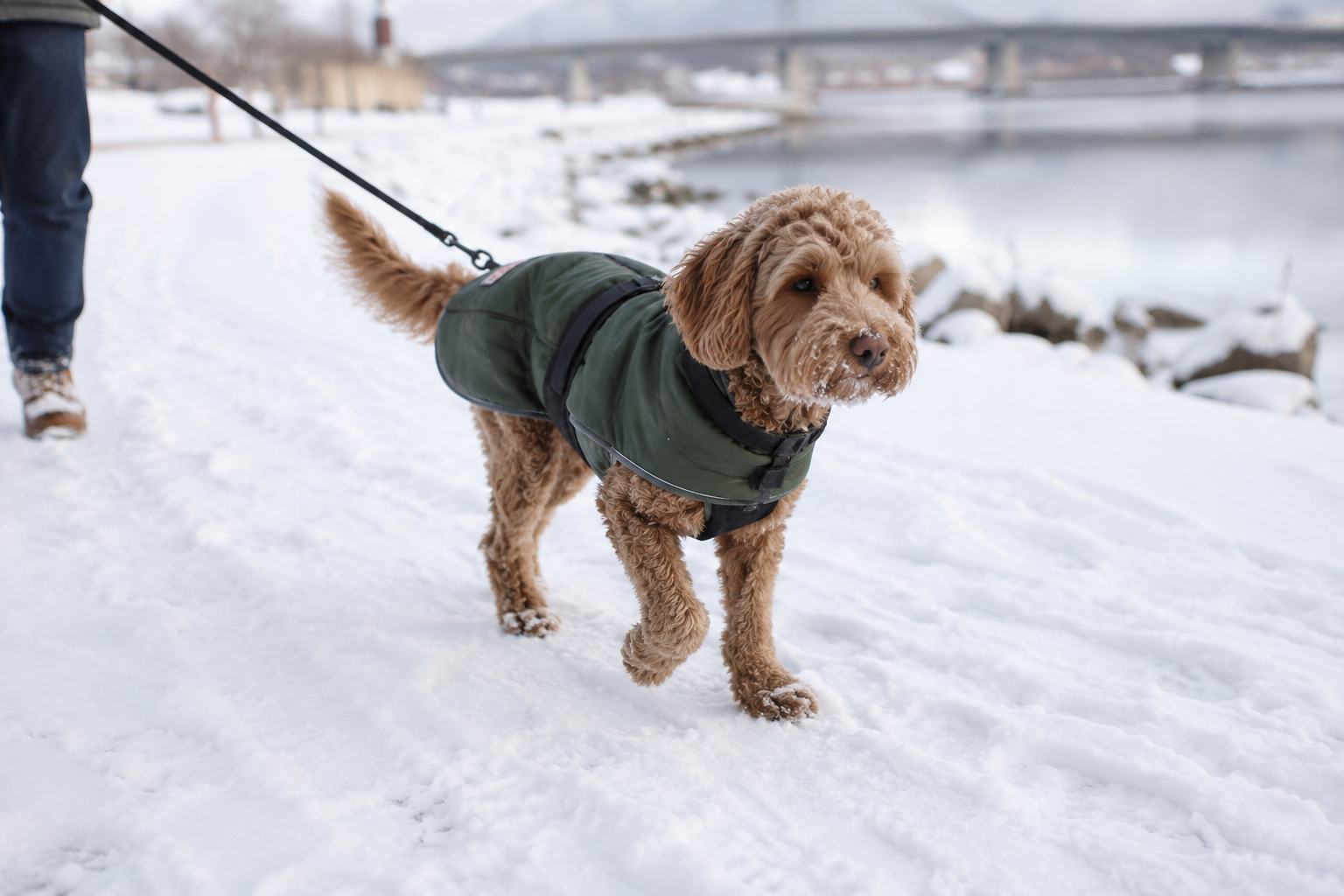
Dog coats, jumpers, and raincoats: what's the difference?
The three garments do different jobs. Most of the confusion online comes from blogs treating them as interchangeable. They’re not.
- A jumper (also called a knit or sweater) is for indoor warmth and mild dry days. Wool, cotton blends, and stretch knits sit close to the body and trap heat. They suit short-haired small dogs at home in winter, layering under a coat on the coldest days, or dry afternoon walks when the temperature isn’t quite cold enough for a full coat.
- A dog coat or jacket is for sustained cold outdoors. Insulated, often with a water-resistant or fleece-lined outer, designed for the walk itself. This is the workhorse garment for Melbourne winter, particularly the morning and evening walks when the temperature sits between five and ten degrees.
- A raincoat is for wet weather, not cold weather. The job is to keep the dog dry. Most raincoats have minimal insulation. They’re useful in Melbourne from late June through August when bay-effect showers can roll in without much warning, but a raincoat on its own won’t keep a thin-coated dog warm on a five-degree morning.
If you walk in all conditions, you’ll likely end up with two garments: a warm coat for cold-and-dry mornings, and a raincoat for wet days. Some products combine both jobs, but compromise garments rarely do either job as well as a single-purpose one.
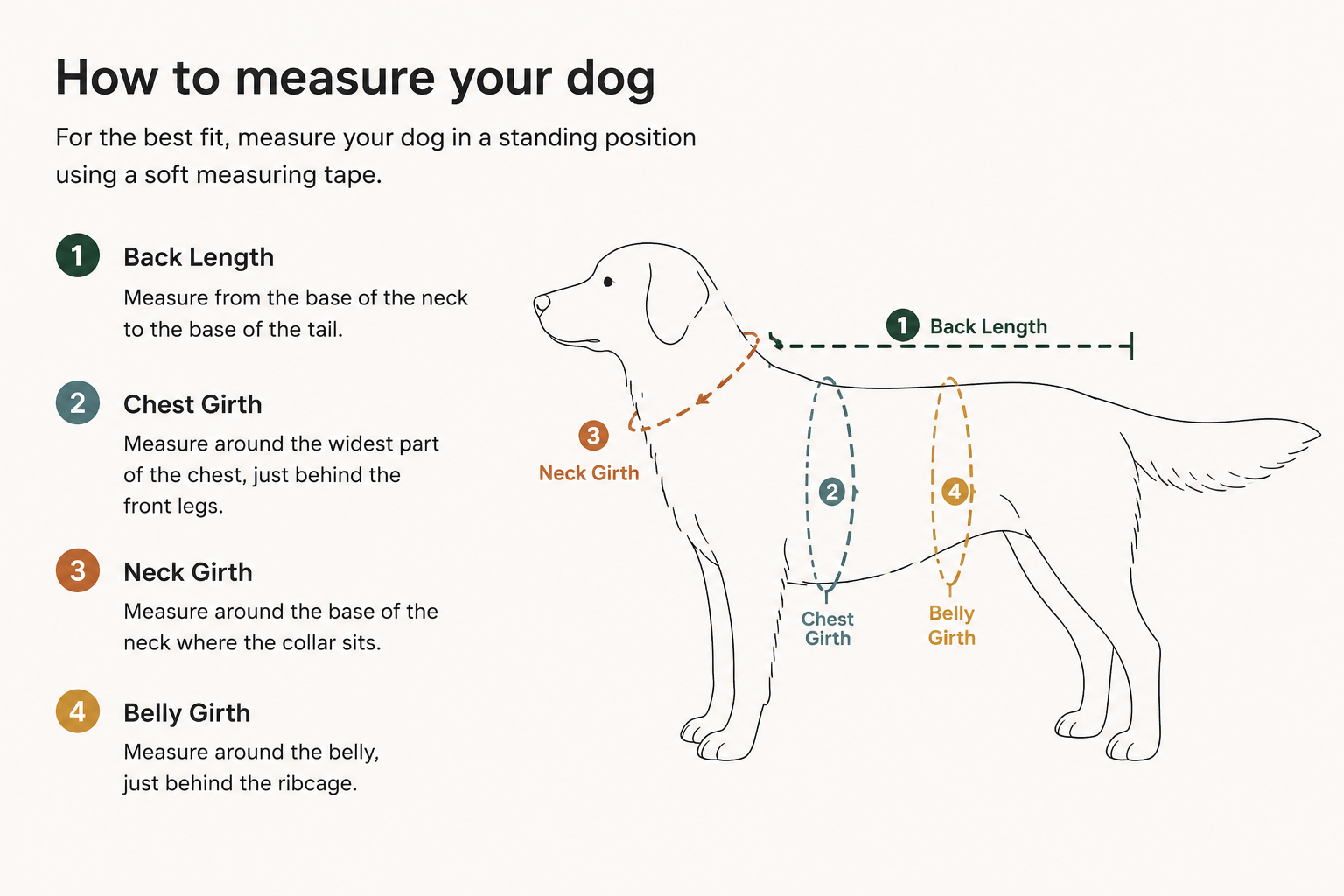
How to measure your dog for a coat or jumper
Brand sizes vary wildly. A size medium from one brand can fit nothing like a size medium from another. Don’t buy by size label. Buy by measurements.
You need four numbers. A soft tape measure is ideal. A piece of string and a ruler also works.
- Back length: From the base of the neck (where the collar sits) to the base of the tail. This is the most important number for coats and jumpers, and the one most sizing charts use first.
- Chest girth: The deepest point around the chest, just behind the front legs. Snug, not tight.
- Neck girth: Where the collar sits, snug.
- Belly girth: Just behind the chest, before the back legs taper in.
Once the coat or jumper is on, the two-finger rule is the easiest fit check: you should be able to slide two flat fingers comfortably under the neck and chest. If you can’t fit two, it’s too tight. If three fit easily, it’s too loose and will slip.
A note on dogs with thick or double coats: press the tape down to the skin when measuring, not over the fluff. Fur adds inches that aren’t really there and leads to oversized garments that don’t sit right.
If your dog falls between sizes, size up rather than down. Adjustable straps fine-tune the fit on a larger size. A smaller size that’s tight has nowhere to go.
Materials and what each one is for
Material is where most buying mistakes happen. The right material for your dog depends on what you want the garment to do.
Wool and knit jumpers are the warmest material per gram of weight. They’re best for indoor wear, dry mild days, and layering under a heavier coat. They’re not for wet weather, since wool holds water and takes hours to dry. The
Louie Living cable knit dog sweater is a typical example: stretch knit, roll-neck collar, pull-over design, sized for medium through extra-large dogs. For smaller dogs after a snug, machine-washable indoor warmer, the DGG Dog Warmie sits in extra small and works well as a sleep layer or under-jacket warmth on the coldest mornings.
Fleece is lightweight, dries quickly, packs down small, and layers well. It’s a good middle option: warmer than knit on its own, lighter than an insulated coat. Best for mild outdoor walks and as a base layer.
Water-resistant nylon and softshell is the Melbourne all-rounder. Lightweight outer, light insulation or fleece lining, drains and dries fast. Most dog coats on the racks in winter sit in this category. The
Kazoo Adventure Dog Coat with Hatch is a good Australian-designed example: waterproof outer, fleece lining, reflective stitching for the dark mornings that arrive in June, and a hatch in the back for harness lead attachment. If you’re only buying one coat for your dog, this is usually the category to buy from.
Insulated puffer and quilted coats are for sustained cold, larger dogs that walk in all weather, or smaller short-haired dogs that genuinely feel the cold. Heavier and warmer than a softshell, with more padding. Less common in Melbourne than they’d be in Canberra or the Victorian high country, but useful for dogs that walk early or late in winter.
Oilskin and waxed cotton is the rugged end of the range. Properly weatherproof, heavier, and built for working dogs or dogs that get filthy in mud and creek water. Not many city dogs need one, but for owners doing weekends in the high country or walks through wet bush, they’re hard to beat.
You can browse the full coats and jumpers collection on the Belvedere’s online store to see what’s currently in stock across these categories.
Where coats commonly fail
Most coats that get returned or left in a drawer fail in the same handful of places. Knowing what to look for saves the return trip.
- Too tight around the chest. The most common failure. The dog can’t take a full breath, doesn’t want to walk in it, and the owner thinks the dog dislikes coats in general. Re-check the chest girth.
- Too long at the back. For male dogs, a coat that extends past the start of the tail interferes with urinating. For all dogs, it can soil at the rear end. The hem should sit at or just before the base of the tail.
- Slipping sideways. Usually a sign the neck opening is cut wrong, or the belly strap is missing or set too loose. Coats with adjustable belly straps fix this almost every time.
- Tight at the leg holes. Causes chafing under the armpit and dogs that refuse to wear the coat after one bad walk. Look for generous, well-cut leg openings.
Check the closure type as well. Velcro is the most common but degrades over time, particularly if the dog rolls in long grass. Clip buckles last longer. Zips behind a fabric flap are the most secure but slowest to put on.
If you walk your dog with a harness, look for coats with a lead hatch or built-in harness access. Putting a coat over the top of a harness usually means taking the harness off to take the coat off, which is a hassle every morning.
Care and storage
Washing instructions vary wildly by material, and getting it wrong shortens the life of the garment.
Knit jumpers usually need hand wash or wool cycle in cool water. Reshape and lay flat to dry. Tumble drying shrinks them. Most synthetic and softshell coats handle a cool machine wash and line drying. Avoid the dryer for anything with a waterproof coating, since heat breaks down the membrane.
Between seasons, wash the coat or jumper before you store it. Wool moths target stored fabric that has skin oil, food residue, or grass on it. Clean and dry, sealed in a plastic tub or zip bag, a coat will come out of storage next May as good as it went in.
Replace when the closures stop holding, the waterproofing has clearly failed, or the coat no longer fits because the dog has grown or changed shape. A well-bought coat lasts three to five winters in regular use.
Frequently asked questions
How do I know if my dog is cold?
The reliable signs are cold ear tips, shivering, hunched posture with the tail tucked, lifting paws off cold pavement, and reluctance to settle outdoors. Don’t rely on the air temperature alone. A damp seven-degree morning with wind feels colder to a dog than a still three-degree morning.
Do puppies need coats?
Most puppies benefit from one for their first winter, particularly small breeds and short-haired breeds. Their thermoregulation isn’t fully developed and they have less body mass to hold heat. Buy something inexpensive, since they’ll outgrow it in months.
Can my dog wear a jumper indoors all day?
Only if the house is genuinely cold and the dog is genuinely struggling. Take it off for sleeping and for warm afternoons. Overheating is a real risk, particularly for brachycephalic breeds (French bulldogs, pugs, Boston terriers, Cavalier King Charles spaniels) that already have trouble cooling themselves.
What size should I buy if my dog is between sizes?
Size up, not down. Look for adjustable straps to fine-tune the fit. A larger coat with straps will fit better than a smaller coat that’s tight in the chest.
Do dogs need raincoats, or is it a fashion thing?
For some dogs, yes. Thin-coated breeds, dogs that get cold when wet, and senior dogs all benefit from staying dry. For thick-coated dogs that don’t mind getting wet and dry off quickly, a raincoat is more for the owner’s car upholstery than for the dog.
Can I leave a coat on my dog all night?
No. Skin needs to breathe, and overnight overheating is a genuine risk. Coats and jumpers come off at bedtime, even on cold nights. If your dog is cold overnight, a heated bed or extra blanket is safer.
Are hoods and high necks safe for flat-faced breeds?
Be careful. Anything that restricts the neck or head movement is a risk for French bulldogs, pugs, Boston terriers, Cavalier King Charles spaniels, and any dog with airway issues. Lower necklines and step-in designs are safer for these breeds.
Where to next
A well-chosen, properly fitted coat or jumper lasts three to five winters. A poorly fitted one lasts one. The ten minutes you spend measuring properly now is what makes the difference.
If you already know what you want, browse the winter coats and jumpers collection on the online store. If your dog is tricky to fit, hard to size, or somewhere between two categories on the breed table above, drop in to the Ivanhoe shop at 93 Upper Heidelberg Road and try a few on with the dog. Dachshunds, French bulldogs, greyhounds and senior dogs in particular are easier to fit in person than from a chart.