
Dog beds: which style suits the way your dog sleeps?
If your dog has a bed but still chooses the sofa, the floorboards, a laundry basket, or a pile of washing, the bed may not match the way they like to sleep.
The best dog beds are chosen by sleep style first, then size, warmth, cleaning, and where the bed will be used. At Belvedere’s Pet Supplies in Ivanhoe, the Sleep collection includes mats, cushions, covered beds, and cat beds that can also suit some small dogs. The right choice depends less on the label and more on whether your dog curls, stretches, leans, burrows, runs hot, or keeps moving between rooms.
Match the bed to the way your dog sleeps
Your dog’s sleeping position is the best starting point because it shows what they find comfortable and secure. Watch where they sleep for two or three nights before buying. A dog that curls into a tight ball needs a different bed from a dog that lies flat across the hallway.
| Sleeping style | Best bed shape | Avoid if |
|---|---|---|
| Curls into a ball | Round, oval, bolstered, or basket-style bed. | Your dog overheats easily. |
| Stretches out long | Cushion bed, rectangle bed, or flat dog mat. | The space is narrow. |
| Leans against furniture | Bolstered bed or bed with raised sides. | Your dog dislikes enclosed edges. |
| Burrows under blankets | Cave, covered, house-style bed, or layered blanket. | Your dog runs hot or chews fabric. |
| Sleeps on hard floors | Mat or cushion with enough padding. | Your dog needs help getting up. |
| Moves between rooms | Lightweight mat or portable bed. | You want one fixed sleeping area. |
| Older or stiff dog | Low-entry, supportive cushion or mat. | The sides are high or hard to step over. |
| Puppy | Washable mat, small cushion, or low-cost starter bed. | The puppy is still chewing bedding. |
A dog that rests its chin on the arm of the sofa often likes a bed with a raised edge. A dog that wedges under a coffee table may prefer a covered bed. A dog that sleeps belly-down on cool tiles may reject a thick, warm bed because it traps too much heat.
The main types of dog beds and what each one is for
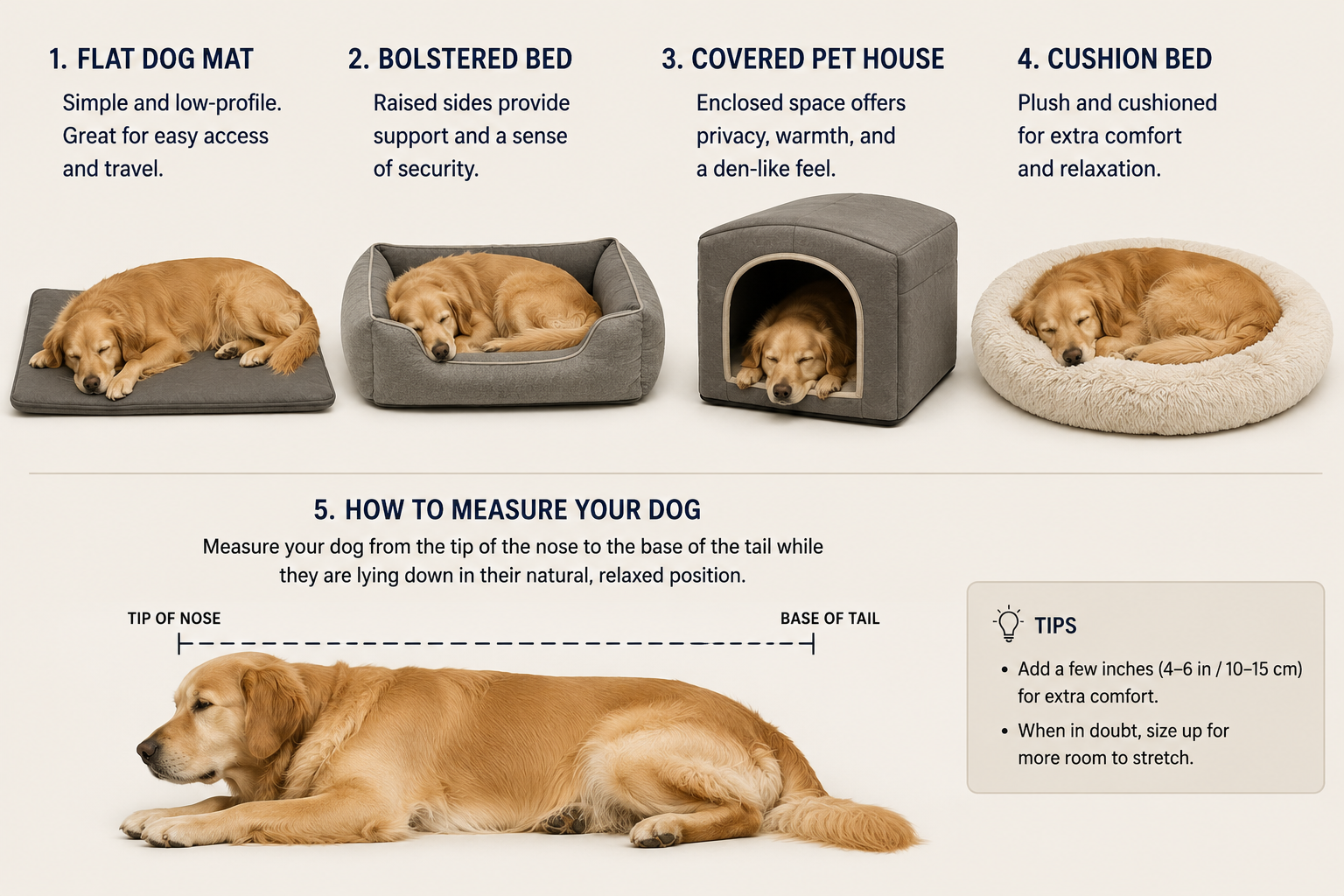
Most dog beds fall into a few practical groups: mats, cushions, bolstered beds, covered beds, and layering pieces such as blankets or sleeping-bag styles. Each one solves a different problem.
Flat mats
A flat dog mat suits dogs that like a low sleeping surface, travel often, sleep in a crate, or move between rooms. Mats are also useful for dogs that run warm because they usually have less side padding.
A mat can work well in an apartment, beside a work desk, in the car, or near the back door where muddy paws are common. A portable mat is easier to shake out than a deep bed and can be moved into a sunny winter spot during the day.
Bolstered beds
A bolstered bed has raised sides that give the dog somewhere to lean or rest their chin. This style suits dogs that press into furniture, curl tightly, or like the feeling of an edge around them.
The downside is access. A high-sided bed may not suit an older dog, a short-legged dog, or a dog recovering from soreness. If the dog has to clamber over the side every time they lie down, a lower cushion or mat is usually kinder.
Cushion beds
A cushion bed suits dogs that stretch, sprawl, or change position during sleep. It gives more usable surface area than a round bed and usually works better for long-bodied dogs.
The key is not to buy too small. If your dog sleeps half on and half off the cushion, the bed is not doing its job. If the bed is huge, though, a small dog may not feel settled. Size matters, but shape matters just as much.
Cave, covered, or house-style beds
Covered beds suit burrowers, nervous dogs, small dogs, cats, and pets that seek shelter under furniture. These beds are not magic anxiety fixes, but the enclosed shape can help some pets settle because the sleeping area feels more protected.
Covered beds need more thought in warmer homes. They can trap heat. They may also be a poor fit for a dog that likes to watch the room while resting.
Blankets and pet sleeping bag styles
A blanket, liner, or pet sleeping bag can be useful when your dog likes to nest. These are not always a replacement for a bed. They are often best as a layer on top of a mat, inside a crate, or packed for travel.
Layering is also practical through Melbourne winter nights. A lighter mat plus a blanket can be more flexible than one very warm bed that becomes uncomfortable in mild weather.
How to measure your dog for a bed
The simplest way to check dog bed size is to measure your dog in the position they use most. Measure once while they are curled and once while they are stretched out.
For a curling dog, measure from the nose around the curve of the body to the base of the tail. Add enough room so the dog can shift position without falling off the edge. For a stretching dog, measure from the nose to the base of the tail, then add room for the legs.
Use these practical checks:
- For curled sleepers, the dog should fit inside the bed without the spine pressing hard against the edge.
- For stretchers, the dog should be able to lie on their side without their hips or shoulders hanging off.
- For long-bodied dogs, measure length before weight. A small but long dog may need a larger bed than expected.
- For puppies, buy for the next growth stage, not just today’s size, unless the bed is a short-term washable starter.
- For older dogs, check entry height as well as bed length. Getting in and out matters.
- For toy lovers, allow room for the favourite toy or blanket if the dog always sleeps with one.
A bed that is too small can push a dog back to the sofa. A bed that is too large can lose the snug feeling that curlers and burrowers often want.
Cleaning, warmth, and where the bed will be used
A good washable dog bed is not just about neatness. It affects odour, skin comfort, flea control routines, and how long the bed stays usable in a real home.
Think about the room before choosing the bed. A bed beside a heater has different needs from a bed near a back door. A bed used in the car needs to be lighter and easier to clean than a bed that stays in the lounge room.
| Home situation | What to look for | Why it matters |
|---|---|---|
| Muddy paws | Removable cover or wipe-clean surface. | Easier weekly cleaning. |
| Cold floorboards | Mat or cushion with insulation. | More comfort on winter nights. |
| Crate use | Low-profile mat. | Fits without reducing headroom. |
| Car travel | Lightweight mat or foldable bed. | Easier to pack and shake out. |
| Apartment living | Compact bed with easy cleaning. | Less odour build-up indoors. |
| Sunny sleeping spot | Breathable fabric. | Less heat trapping. |
| Older dog | Low-entry cushion or mat. | Easier to step on and off. |
Removable covers help, but they are only useful if the owner will wash them. Check whether the whole bed can be washed, whether only the cover comes off, or whether it should be spot-cleaned. If your dog sheds heavily or comes home damp from walks, cleaning should sit near the top of the decision.
Warmth also needs balance. Some dogs seek warmth. Others abandon warm beds after ten minutes because they overheat. Short-coated dogs, smaller dogs, and older dogs often appreciate warmth more than thick-coated dogs.
When a dog bed is not the whole answer
A dog bed can make rest more comfortable, but it will not fix pain, anxiety, or a major behaviour change on its own. If your dog suddenly avoids lying down, seems stiff, pants at rest, cries when getting up, or changes sleeping spots overnight, speak with a vet.
Chewing is another clue. Puppies often chew bedding because they are exploring and teething. Adult dogs may chew from boredom, stress, separation issues, or habit. In those cases, buying a more expensive bed may not solve the problem.
Practical steps can help:
- Put the new bed where the dog already chooses to rest.
- Add a familiar blanket for scent.
- Reward calm use of the bed without forcing the dog onto it.
- Avoid giving an unsupervised soft bed to a dog that swallows fabric.
- Speak with a vet or qualified trainer if chewing is intense, anxious, or sudden.
A “calming dog bed” should be treated as a comfort product, not a treatment. The shape and softness may help some dogs settle, but ongoing anxiety needs proper advice.
Choosing dog beds from Belvedere's Sleep collection
Belvedere’s Sleep collection is best used as a set of options to match the dog’s habits, not as a one-size-fits-all list. Check the individual product page and variant before publishing or buying, because some collection cards may show a broad sold-out label while individual variants are still available.
Here are useful examples by use case:
| Product type | Example to check | Best suited to |
|---|---|---|
| Portable dog mat | Airy Vest Dog Mat, Medium or Large | Dogs that move rooms, travel, or sleep on cooler floors |
| Cushion bed | Fur Personality Medium Designer Dog Bed | Medium dogs that stretch or like a broad surface |
| Soft cushion | Zolux Soft Cushion, Castle Grey | Dogs or cats needing a simple removable-cover cushion |
| Covered pet house | Airy Vest Pet House Small | Small dogs or cats that like shelter |
| Cat or small dog basket | FuzzYard Life Cat Bed, Rope Basket | Cats and very small dogs that curl tightly |
For a dog that sleeps stretched out, start with a cushion or mat. For a dog that circles, nests, and tucks in tightly, look at a basket, bolstered style, or covered bed. For a dog that follows you from room to room, a portable mat may get used more than a bulky bed that stays in one corner.
Cat beds can sometimes work for small dogs, but the measurements need to be checked carefully. A 38 cm basket may suit a cat or tiny dog that curls tightly, but it will not suit a small dog that sprawls.
Dog bed FAQs
What size dog bed should I buy?
Buy a dog bed that matches your dog’s sleeping position, not just their weight. Measure your dog curled and stretched, then choose the size that gives enough room to shift position. For stretchers, length matters most. For curlers, the bed should feel snug without pressing the dog into the sides.
Are bolstered beds better than flat beds?
Bolstered beds are better for dogs that lean, curl, or rest their chin on an edge. Flat beds are better for dogs that stretch out, run warm, sleep in crates, or need easy step-on access. Neither style is better for every dog.
Why does my dog ignore its bed?
A dog may ignore its bed because the bed is too warm, too small, too exposed, too soft, too firm, or in the wrong spot. Put the bed where the dog already rests and add a familiar blanket before replacing it.
Why does my dog ignore its bed?
A dog may ignore its bed because the bed is too warm, too small, too exposed, too soft, too firm, or in the wrong spot. Put the bed where the dog already rests and add a familiar blanket before replacing it.
Do puppies need a different bed?
Puppies often need a washable, lower-cost bed while they are growing and chewing. A deep or expensive bed can wait until their adult size and sleeping habits are clearer. Keep safety in mind if the puppy tears and swallows fabric.
What is the easiest dog bed to clean?
The easiest dog bed to clean is usually a flat mat, a bed with a removable washable cover, or a cushion with a wipeable surface. Deep beds and covered beds can still be good choices, but they need more cleaning time.
Should older dogs use a softer bed?
Older dogs often need comfort, but softer is not always better. A bed that is too soft can make it harder to get up. Look for support, low entry, and enough surface area. Ask a vet if stiffness or soreness is new.
Can a cat bed be used for a small dog?
A cat bed can work for a small dog if the size, entry height, and shape match the dog. Check the diameter or internal measurements. Many small dogs curl like cats, but others stretch out and need more room.
Final advice
Choose the bed by watching the dog first. The best clues are already there: where they sleep, how tightly they curl, whether they seek warmth, and whether they want an edge, a roof, or an open surface.
Browse the Sleep collection online, or bring rough measurements into Belvedere’s Pet Supplies at 93 Upper Heidelberg Road, Ivanhoe VIC 3079. A quick size check in-store can save you from buying a bed your dog politely ignores.