
Dog leads explained: how to choose the right one for your dog
Picture a 45kg labrador on a 6mm beaded nylon lead. Or a 6kg terrier dragging a 25mm leather lead that weighs more than her head. Both happen, often. Most owners pick a lead based on what looks nice on the rack or what fits the budget that week.
At Belvedere’s Pet Supplies in Ivanhoe, we sell dog leads alongside running a dog walking service. That gives us a direct view of which leads hold up on a real morning walk and which don’t. The ones that come back “broken” or “uncomfortable” usually trace to the same handful of choices made at purchase.
This guide walks through the main lead types, what each does well, and how to match the lead to your dog, your walk and your hand. One good lead that fits the job, not three average ones in a drawer.
Quick reference: which dog lead suits which situation
A fast scan before the detail. Each lead type has a use case it handles well and one it doesn’t.
| Lead type | Best for | Avoid if |
|---|---|---|
| Standard fixed (1.2 to 1.8m) | Most adult dogs on suburban walks | Your dog pulls hard and you have a sore shoulder |
| Rope lead | Medium and large dogs; owners who want grip and feel | Small dogs or hands that struggle with a thicker grip |
| Leather lead | Owners who want a lead that softens and lasts decades | Tight budget; first lead for a puppy that chews |
| Training long line (4 to 10m) | Recall training; beach and park work; dogs not yet reliable off-lead | Suburban footpath walking; dogs that don’t pull at all |
| Hands-free / hip belt | Running, hiking, pram walking | Dogs that lunge or pull unpredictably |
| Retractable | Calm dogs in open spaces; sniff walks | Strong pullers; crowded paths; training contexts |
| Slip lead | Vet visits; quick handling; situations without a collar | Daily walking; pullers; ever as a primary lead |
| Double-clip / training lead | Trainers using two attachment points; front/back clip transitions | Casual owners who just want one lead |
The main types of dog leads explained
Standard fixed leads
This is the lead most people picture: a single length of webbing or rope, one clip, a loop at the other end. The everyday workhorse for adult dogs on a footpath walk. The cheap end of the market is where these fail: thin webbing, light zinc clips that pop under load, no handle padding. A standard lead from a serious brand outlasts three supermarket versions.
Rope leads
Marine-grade rope leads are the upgrade for medium and large dogs. The rope sits comfortably in the hand and holds up in wet weather. Brass clips on the better brands outlast spring clips by years. The Animals In Charge All Weather Rope Leash is hand-made in Melbourne and at $50 it’s a buy-once piece of kit. The thicker grip works against you with small hands or a small dog.
Leather leads
A well-made leather lead softens as you use it and lasts decades if you condition it. The Dogue Foxy leather lead is hand-made in Australia using New Zealand leather. Two flags: leather isn’t for puppies that chew, and most decorative leather leads aren’t built for the beach, the rain or a hose-down. If you want one lead for every condition, leather isn’t it. If you want character that lasts ten years, leather is excellent.
Training long lines
A training long line is four to ten metres of light cord for teaching recall in open space. The dog has the feel of running free; you have a backup. Long lines belong at the park or beach, not on a suburban footpath. The owners who need one are usually working through a phase where the dog isn’t yet reliable off-lead. 5m is the standard starting point.
Hands-free leads
A hands-free lead loops through a hip belt or carabiner so your hands stay free. The setup suits running, hiking and pushing a pram. It only works if the dog runs at your pace and doesn’t lunge. The DOOG Clip It is a soft entry point at $29.95. The DOOG NEOSPORT Hip Belt is the dedicated solution for runners.
Retractable leads
Retractables divide opinion. Used right they’re fine; used wrong they cause injuries. The locking mechanism can fail under sudden load. The thin cord can burn or cut hands and legs. The long extension makes fine control near traffic almost impossible, and the constant tension undermines loose-lead training. Where they work: calm dogs in open spaces on a sniff walk. Where they don’t: strong pullers, crowded paths, traffic, training contexts.
Slip leads
A slip lead is a single piece of rope or webbing with a loop that tightens around the dog’s neck when they pull. The design comes from working and gundog handling, where the dog is trained not to pull. Slip leads have a place: vet visits, quick handling, the carpark when you’ve left the collar at home. Not a daily walking lead. Not a tool for stopping a puller.
Double-clip and training leads
A double-clip lead has a clip on each end and rings along its length, designed to attach to two harness points at once. Trainers use them on strong pullers because two attachment points give better steering. The Coralpina Cinquetorri training lead from Italy adjusts to three lengths up to 2.25m and works as a regular lead, a hands-free shoulder lead, or a tether. Most casual owners are better off with one good standard lead.
Matching the lead to your dog (and your hand)
Most articles on dog leads list the types and leave you to work out the match. Here it is.
- Small to medium dog, calm, suburban footpath: a standard fixed lead, 1.5m, soft webbing or thin rope. Light handle, light clip. Nothing fancy.
- Large dog that pulls: a 12mm rope lead, 1.2 to 1.5m. Shorter is better with a puller. A longer lead just gives them more run-up. The lead is only half the decision: where it clips matters as much. We’ll cover the harness or collar decision in detail in the next post.
- Puppy in early training: a lightweight fixed lead, 1.2 to 1.8m, paired with a well-fitted harness. Save the long line for later, when you’re working on recall.
- Reactive or nervous dog: a short, comfortable lead you can shorten quickly when you spot a trigger. A double-handle lead (one near the clip, the main handle further back) helps a lot. Our owners Karen and Joe both have rescue dogs and have walked this part of the decision themselves.
- Running with your dog: a hands-free hip belt and a bungee-style lead, but only if the dog reliably runs at your pace. A reactive dog or a lunger is not a running partner.
- Beach or park dogs not yet reliable off-lead: a 4 to 10m training long line. Light enough that it doesn’t drag the dog backwards when it slackens.
- Two dogs walked together: two separate leads in two hands, or a coupler attachment. Don’t try one double-clip lead unless both dogs are well-trained. Two pullers on one handle is how shoulders get hurt.
Dog lead length and width: getting the size right
Length and width are the next common mistakes.
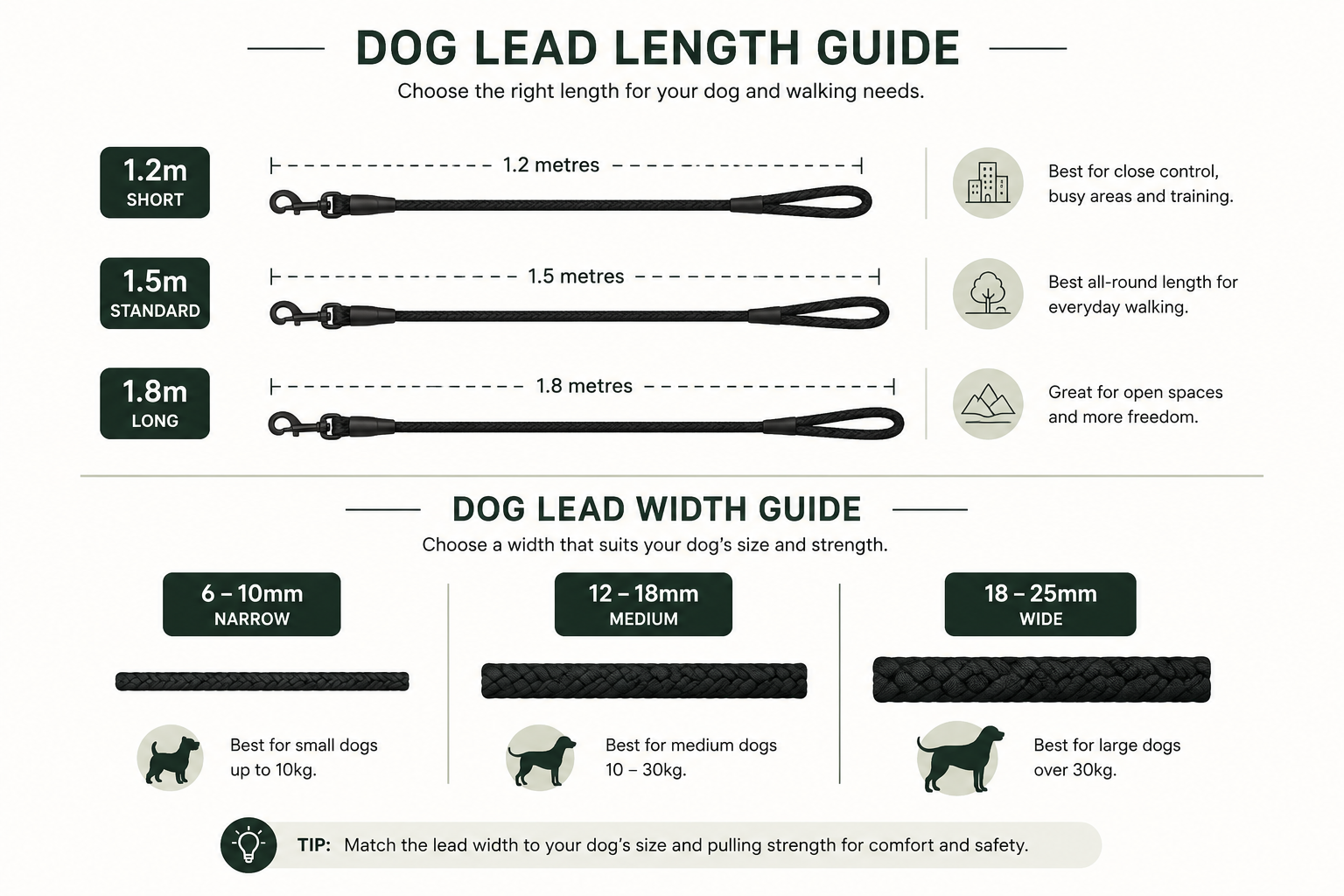
Length
For most adult dogs on a suburban walk, 1.2 to 1.8m is the working range:
- 1.2m gives tight control near traffic or in crowds
- 1.5m is the everyday default for most dogs
- 1.8m gives more sniffing room on quieter streets
Anything longer than 2m drags or tangles. If you want length for park or beach work, buy a separate long line rather than stretching your everyday lead.
Width
Match width to the dog’s pulling force, not just the dog’s size:
- 6 to 10mm for small dogs (under 10kg)
- 12 to 18mm for medium and large dogs
- 18 to 25mm for big dogs or pullers, where the hand needs cushioning
The handle matters too. Padded handles, neoprene grips, or a second handle near the clip all reduce shoulder strain. A red mark across your palm after a walk means the wrong handle.
Caring for your lead and knowing when to replace it
A good lead lasts five to ten years if you look after it. A cheap lead lasts one to two.
Wash nylon and rope leads in mild detergent every couple of months to clear oils, grass and saliva, then line dry. Leather leads need conditioner every six to twelve months. Check the clip and stitching monthly. A sticking clip means the spring is going. Fraying stitching is where the lead will fail next.
Replace a lead the moment a clip fails, stitching opens at a stress point, or the rope or webbing
Frequently asked questions
What’s the best length for an everyday dog lead?
1.5m is the everyday default for most dogs on a suburban walk. It gives the dog enough room to walk naturally without leaving you fighting slack. 1.2m suits crowded areas and traffic; 1.8m suits quieter streets.
Are retractable dog leads safe?
On a calm dog in open space on a sniff walk, they’re fine. On a strong puller, near traffic, or on a crowded path, they cause injuries. The main risks are cord burns to hands and legs, and the lock failing under sudden load when a dog bolts. If you walk anywhere with cars or other dogs, a fixed lead gives you control a retractable can’t.
What’s the best dog lead for a puppy?
A lightweight fixed lead, 1.2 to 1.8m, with a small clip suited to a puppy collar or harness. Avoid heavy leather while they’re still chewing. Skip retractables during early training. The constant tension teaches the puppy that pulling works.
Should I use a different lead for training and walking?
For most owners, one good lead handles both. The exception is recall training, which needs a long line at the park or beach as a second lead. Double-clip leads with a front-clip harness are specialist gear.
Is a leather dog lead worth the extra money?
Yes, if the dog isn’t a chewer and you don’t walk in wet conditions every day. A well-made leather lead conditioned once or twice a year will outlast three or four nylon leads. No, if you walk on the beach often or the puppy still treats everything as a chew toy.
What’s the strongest dog lead I can buy?
For most owners, a 12 to 16mm marine-grade rope lead with a solid brass or stainless steel bolt snap. Rope leads carry load through the whole length rather than at a single stitch point, and brass clips don’t corrode or fatigue the way zinc-plated spring clips do. Strength claims on cheap leads are usually about the webbing, not the clip; the clip is what fails first.
How do I stop my dog lead from twisting in my hand?
Most twisting is the dog turning a circle on the same spot, usually while sniffing. A swivel clip at the dog’s end lets the lead untwist as the dog moves. If your lead doesn’t have one, you’ll be untwisting it every walk. The other fix is a slightly shorter, thicker lead.
Where to next
A well-matched lead changes the experience of walking your dog. The ten minutes you spend picking the right lead now is the ten minutes you don’t spend battling the wrong one for five years.
If you want to browse, the Walk collection at the Belvedere’s shop carries leads, harnesses and walking gear with national shipping. If you have a tricky dog (a strong puller, a reactive dog, a two-dog household, or a puppy you’re not sure how to fit out), drop in to the Ivanhoe shop at 93 Upper Heidelberg Road. We can put the lead in your hand, watch your dog move, and tell you what’s going to work.